Every successful business owner and facility manager understands the importance of making a great first impression. One often-overlooked detail that literally and figuratively guides people in and out of your facility is pavement markings. Crosswalks, directional arrows, stop lines, fire lanes, ADA stalls, designated parking spots, and EV charging stations all contribute to the safety and organization of your property. When properly installed, these markings are more than just lines on the pavement; they’re essential safety and navigation tools.
Two of the most common materials used for parking lot projects are thermoplastic markings and traditional traffic paint. Need help determining which is the right option for your project? You’ve come to the right place!
What Are Thermoplastic Pavement Markings?
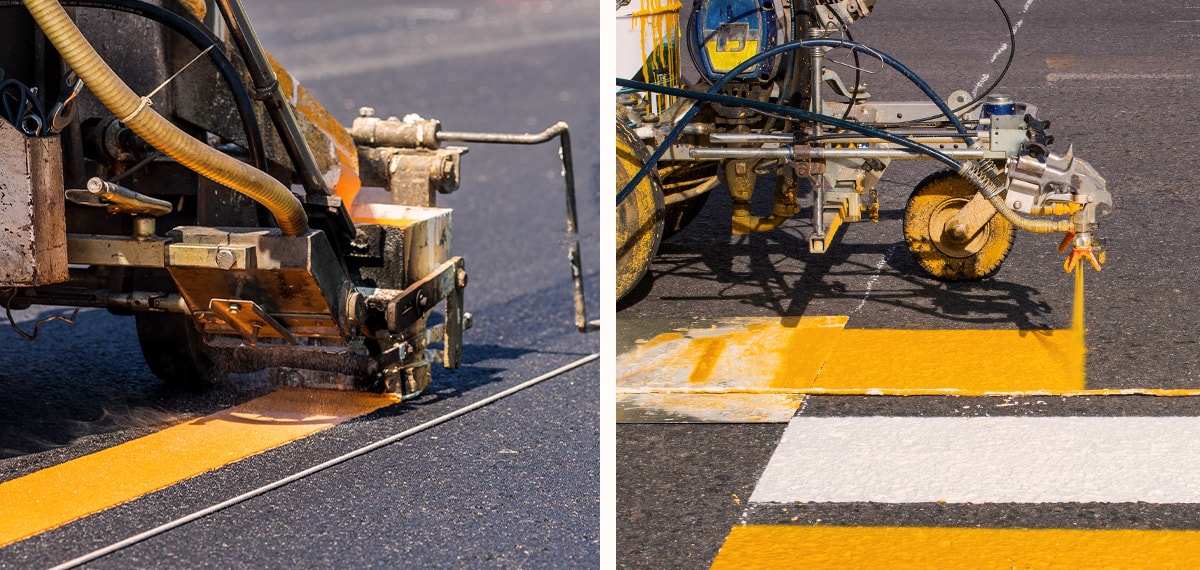
Thermoplastic pavement markings are not paint, but a durable plastic material made from pigments, synthetic resins, and glass beads. The material is heated to its melting point in specialized equipment and then applied in liquid form to the prepared surface. Once applied, it cools and hardens quickly, bonding to the pavement and creating a tough, long-lasting surface marking.
These pavement markings may also come in what’s known as preformed thermoplastic, meaning the material is ready made and pre-cut to a specific shape or symbol. Preformed thermoplastics are simply placed on the asphalt surface and heated with a propane torch.
Because thermoplastic markings set rapidly, trained professionals must apply them precisely using specialized equipment to ensure clean lines and proper adhesion.
Common Use Cases for Thermoplastics
The most common use cases for thermoplastic markings include:
- Crosswalks
- Directional arrows
- Speed bumps
- Highways
- School zones
All of these instances require maximum durability and reflectivity to ensure safety.
3 Advantages of Thermoplastic Markings
- Durability: Thanks to its super-heated, quickly applied application, thermoplastic paint is an exceptionally durable material that withstands extreme fluctuations in temperature, inclement weather, strong sun exposure, and heavy traffic.
- Visibility: Embedded glass beads give thermoplastic markings excellent reflectivity, making them bright during the day and highly visible at night.
- Adhesion: When applied at high temperatures, thermoplastic bonds tightly to asphalt and concrete, even conforming to minor cracks or surface irregularities.
3 Disadvantages of Thermoplastic Markings
- Technical Application: The equipment required to apply thermoplastic makes it a more complex process requiring more highly skilled professionals than traditional traffic paint. Asphalt contractors may either use a melting machine or propane torch to apply the thermoplastic material.
- Permanence: Because thermoplastic bonds so strongly to the pavement, modifying or removing it later can be challenging and time-consuming.
- Up-Front Cost: Given its technical components, the need for specific equipment, its quick drying, and small room for error, the initial cost of thermoplastic installation is higher than that of traffic paints.
What is Traditional Traffic Paint?
Traditional traffic paint, often made from waterborne acrylic formulations, remains a popular choice for parking lots, roadways, and other paved surfaces. It’s designed for ease of application and quick drying, and most products meet federal performance standards, including TT-P-1952E compliance for airfield and roadway markings.
G-FORCE® Parking Lot Striping trusts Sherwin-Williams products coupled with Graco’s top-of-the-line line striping machines for pavement marking applications.
Common Use Cases for Traffic Paint
The most common use cases for traffic paint application include:
- Parking stall lines
- Fire lane markings
- ADA stalls
- Warehouse lines
These markings tend to be high-volume and require flexibility for new layouts. Therefore, the cost, speed of application, and flexibility of traffic paints trumps thermoplastics.
3 Advantages of Traffic Marking Paints
- Simplicity: Traditional traffic marking paints are easy to apply and highly versatile.
- Ease of Modification: Touching-up, adjusting, and removing traditional pavement marking paint is simpler than thermoplastic and requires no specialized equipment.
- Low Initial Cost: Up-front costs for both materials and installation are typically lower for traditional parking lot paints versus thermoplastics.
3 Disadvantages of Traffic Marking Paint
- Durability: Traffic paint is less durable than thermoplastic paints and can require frequent touching-up or reapplication in high-traffic and high-exposure areas.
- Visibility: Traditional paint is less reflective than thermoplastic markings. It also fades more quickly over time with exposure to traffic and the elements.
- Long-term Cost: Lower durability, fading, and the general need for more regular restriping increase the long-term costs of using traditional paint for pavement marking.
How to Make the Best Choice for Your Parking Lot
Deciding between thermoplastic markings and traditional traffic paint depends on your property’s traffic volume, budget, and maintenance schedule. High-traffic areas that demand longevity and reflectivity often benefit from thermoplastic, while properties needing flexibility or frequent updates may prefer traditional paint. In many cases, a mix of both may be recommended for a property. For example, we often stripe a lot with traffic paint, but install thermoplastic crosswalk markings that require extra reflectivity at night.
No matter which material you choose, working with the right professionals makes all the difference. The experts at G-FORCE® Parking Lot Striping will assess your property, discuss your goals, and recommend the most effective pavement marking solution.
Find a location near you today to discuss the right pavement markings for your property. With a network of 51 Veteran-owned and operated locations nationwide, we promise to show up on time, in uniform and be accountable for all our business practices.